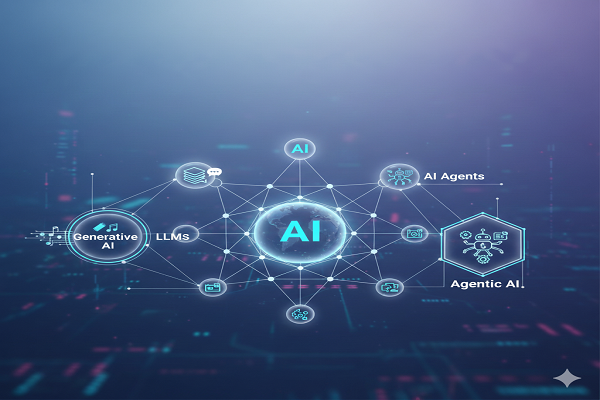
Artificial Intelligence has become one of the most transformative forces of our time. Yet, for many people, the world of AI seems filled with complex terms — AI, Generative AI, LLMs, AI Agents, and now Agentic AI.
Let’s unpack these concepts one by one in a simple and practical way — and understand how they all connect.
💡 What Is Artificial Intelligence (AI)?
At its core, Artificial Intelligence (AI) is about making machines think and act intelligently.
AI systems learn from data, recognize patterns, and make decisions — just like humans, but often faster and at a much larger scale.
Examples:
-
When Google Maps suggests the fastest route.
-
When your email filters out spam.
-
When Netflix recommends shows you might like.
All of these are forms of AI — designed to assist, predict, and optimize.
Think of AI as the broad umbrella under which all other advanced technologies (like GenAI, LLMs, and AI Agents) fall.
✨ What Is Generative AI (GenAI)?
While traditional AI focuses on analysis — predicting, classifying, or optimizing — Generative AI focuses on creation.
It generates new content such as text, images, code, music, or even videos.
In simple terms:
Traditional AI tells you what is;
Generative AI creates something new.
Examples:
-
ChatGPT writing an article or answering questions.
-
DALL·E creating original artwork.
-
Synthesia generating human-like video presenters.
Generative AI models use huge amounts of data and advanced neural networks to learn patterns and then “imagine” new outputs that resemble human creativity.
It’s what powers much of today’s AI revolution — transforming how we work, learn, and create.
🧠 What Are Large Language Models (LLMs)?
Large Language Models (LLMs) are the powerful engines behind most Generative AI tools.
They are trained on enormous amounts of text from books, articles, and websites — learning grammar, facts, reasoning, and even subtle nuances of language.
Think of an LLM as the ‘brain’ of Generative AI.
When you interact with ChatGPT, Gemini, Claude, or LLaMA, you’re actually talking to an LLM.
It doesn’t “understand” language like humans do, but it predicts the next word based on patterns it has learned — with astonishing fluency.
In short:
LLMs → enable machines to communicate, explain, and create in natural human language.
🧑💻 What Are AI Agents?
Now, let’s take things a step further.
What if AI could not only generate content — but also act on it?
That’s where AI Agents come in.
An AI Agent is a system that can plan, reason, and perform tasks to achieve a goal.
It uses models like LLMs but combines them with tools, memory, and logic.
Example:
Imagine you ask an AI to “book me a flight, prepare a travel itinerary, and summarize my schedule.”
A simple chatbot can’t do that — but an AI Agent can:
-
Search flights online,
-
Book tickets through APIs,
-
Create a summary using your calendar, and
-
Send you an email with the details.
It’s AI that does things, not just talks about things.
AI Agents are the foundation of the next generation of intelligent automation.
🚀 What Is Agentic AI?
Now we’re entering the newest and most exciting phase — Agentic AI.
If AI Agents are like digital assistants, Agentic AI is like having a digital coworker.
Agentic AI systems are autonomous, goal-driven, and context-aware.
They don’t just execute instructions — they can reason about goals, make decisions, and adapt based on feedback.
Example:
You give an Agentic AI a broad goal like “Create a 3-month marketing plan for a new product launch.”
It can:
-
Research competitors,
-
Generate multiple ideas,
-
Build a timeline,
-
Create content drafts,
-
And adjust its plan based on results or new data.
In short, Agentic AI represents AI that thinks, plans, and acts intelligently — with minimal human supervision.
🔗 How These Concepts Connect
Here’s how it all fits together:
| Concept | Description | Example |
|---|---|---|
| AI | The overall field of intelligent machines | Recommendation systems, voice assistants |
| Generative AI | AI that creates new content | ChatGPT, Midjourney, DALL·E |
| LLMs | The language core of most GenAI tools | GPT-4, Claude, Gemini |
| AI Agents | AI that performs tasks and automates workflows | AutoGPT, CrewAI, LangChain agents |
| Agentic AI | The next stage — autonomous, reasoning-driven AI | Devin AI, OpenDevin, custom enterprise AI copilots |
You can think of this evolution as:
AI → Generative AI → LLMs → AI Agents → Agentic AI
Each builds upon the previous — making machines progressively more capable of understanding, creating, acting, and reasoning.
🌍 The Road Ahead
We’re witnessing a shift from AI that assists ➜ to AI that collaborates ➜ to AI that takes initiative intelligently.
Agentic AI could redefine how we interact with technology — moving from tools we use to intelligent systems we work alongside.
It’s an exciting time to learn, experiment, and imagine what’s next.
🏁 Final Thoughts
If you’re just starting your AI journey:
-
Understand the basics of AI and Generative AI.
-
Play around with tools like ChatGPT or Claude.
-
Explore how AI Agents can automate your workflows.
-
And keep an eye on how Agentic AI evolves — it’s the frontier of intelligent systems.
The key is not just learning what AI can do, but thinking what you can do with AI.
A practical guide to help you start on your AI journey
If you are looking to get started with Generative AI, we recomend you check out our E-Book Generative AI Made Simple: From Fundamentals to Real-World Applications for Professionals and Students — a clear, practical guide designed to help anyone learn and apply Generative AI faster.
It’s a hands-on, beginner-friendly resource that breaks complex concepts into simple, real-world lessons, covering:
-
The evolution and inner workings of Generative AI 🧩
-
How to craft effective prompts for better AI responses 💬
-
Using AI tools for writing, presentations, and visuals 🖋️🎨
-
Applying AI in data analysis, automation, and coding 💻
-
Practical, industry-specific applications 🔍
-
Ethics, compliance, and the future of responsible AI 🌍
Whether you’re a student eager to understand AI fundamentals or a professional looking to integrate AI into your daily work, this guide will help you move from curiosity to confidence — and start leveraging AI effectively from day one
📘 Get your copy now